1. The ESO model is being rewritten
Engineering Services Outsourcing used to be straightforward. You needed twenty CAD designers in Hyderabad, fifteen FEA analysts in Krakow, or a stress team in Bengaluru. You scoped headcount, agreed on a billing rate, signed a master services agreement, and waited for drawings to come back. The unit of work was the engineer-hour. The vendor that could deliver the lowest rate per hour usually won the deal.
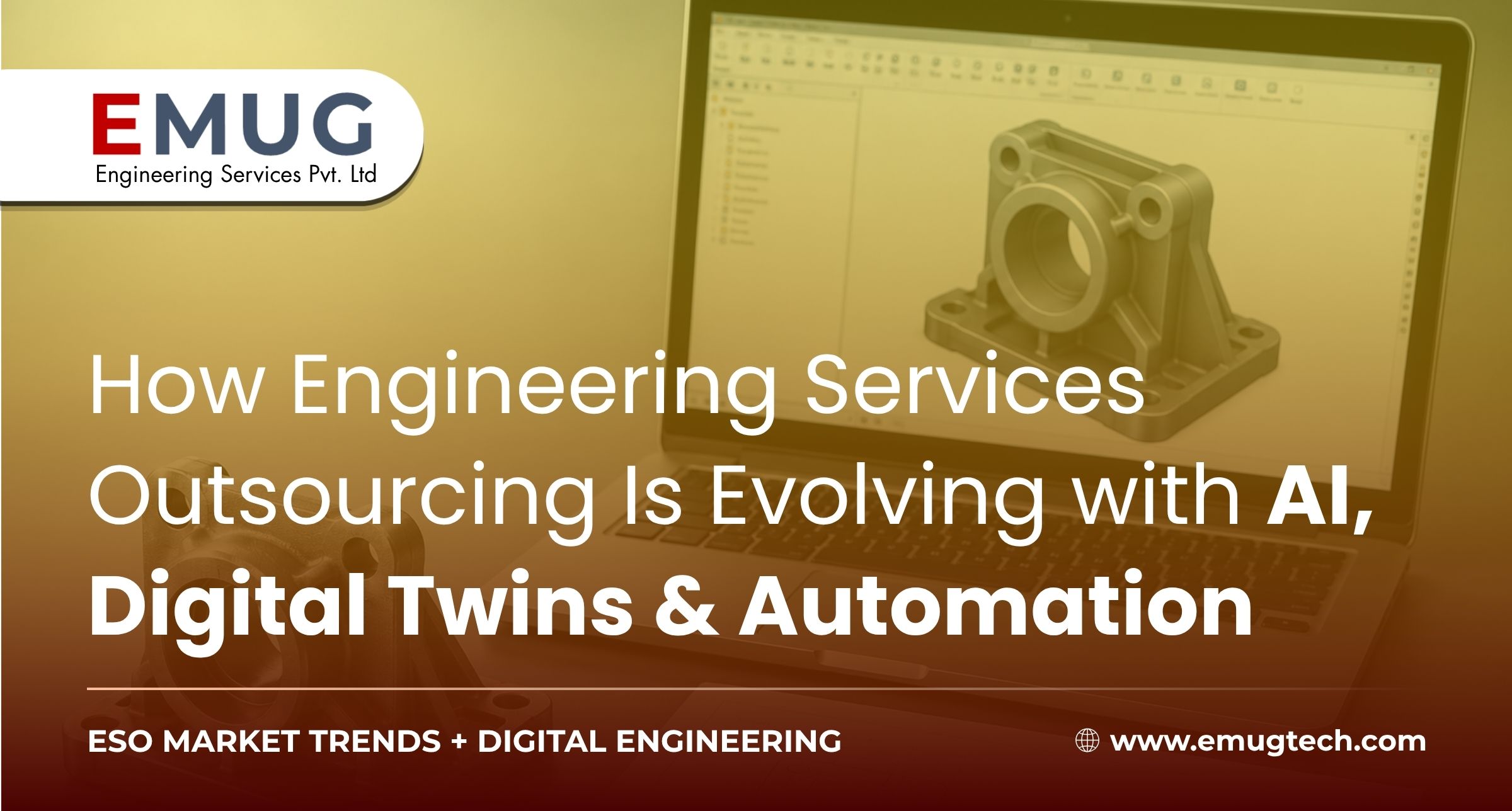
That model is quietly being replaced. AI is taking out the repetitive parts of engineering work. Digital twins are letting design and validation happen against virtual products before any metal is cut. Automation is collapsing weeks of workflow into hours. The new question is not how cheap is the hour, it is how much engineering can your partner take off your plate per dollar spent. That is a different conversation.
2. Old ESO vs AI-augmented ESO


3. Why EMUG Tech for next-generation ESO
EMUG Tech delivers engineering services for automotive OEMs and Tier 1 suppliers, aerospace and defence primes, industrial machinery builders, energy companies, and high-tech manufacturers across more than 20 countries in Europe, the Middle East, Asia-Pacific, the Americas, and Africa. Our model is built around the three forces above, not bolted onto a legacy staffing business.

AI capabilities we deploy: generative AI for engineering documentation and knowledge access, computer vision for inspection, predictive analytics for quality and reliability, engineering AI assistants over PLM and SAP data, and Robotic Process Automation for ECN, PPAP, and BOM workflows.
Twin platforms we work in: Siemens Teamcenter and Xcelerator, Dassault 3DEXPERIENCE, PTC ThingWorx, ANSYS Twin Builder, AVEVA, and SAP Digital Manufacturing. Engineering platforms covered: NX, Creo, CATIA, Windchill, with SAP PLM, EAM, and S/4HANA on the enterprise side.
4. Metrics that move when ESO modernises
Directional ranges observed when clients shift from a headcount-led model to an AI-augmented, twin-enabled engagement with EMUG Tech.

5. Frequently asked questions
Q1. What does AI-augmented ESO actually mean, and how is it priced?
It means the engineering partner brings AI accelerators, reusable model libraries, and automation pipelines into the engagement, not just engineers. Pricing usually shifts from pure time and materials to a blended model: an outcome or milestone component for the work that the AI and automation reliably deliver, and a managed-capacity component for the engineering judgement that still needs humans. Clients typically see a 25 to 40 percent reduction in total cost compared with a headcount-only contract for the same scope.
Q2. Where do digital twins fit into modern engineering services delivery?
Twins move validation upstream. Instead of waiting for a physical prototype to test design choices, the engineering team simulates the product against a live virtual model that mirrors geometry, materials, control logic, and operating conditions. EMUG Tech builds twins on Siemens Teamcenter, 3DEXPERIENCE, ANSYS Twin Builder, and SAP Digital Manufacturing, and wires them into PLM and MES so design changes propagate automatically to the twin and back into production planning.
Q3. Which countries does EMUG Tech serve, and how is delivery structured?
We deliver across Germany, France, the UK, Netherlands, Sweden, Italy, Spain, Poland, UAE, Saudi Arabia, Qatar, India, China, Japan, South Korea, Malaysia, Thailand, USA, Canada, Mexico, Brazil, South Africa, Nigeria, and Kenya. Onshore engineers sit in major automotive, aerospace, and energy hubs for client-facing work, while engineering centres in India run twin development, AI model training, and SAP plus PLM integration around the clock.