Engineering leaders today face a common challenge: demand for innovation is growing faster than internal engineering capacity.
Whether you’re launching a new product, scaling an engineering function, accelerating digital transformation, or supporting multiple customer programs, the question isn’t whether you need external engineering support it’s choosing the right engagement model.
Many organizations default to the model they’ve used before. But selecting the wrong engagement approach can lead to missed deadlines, cost overruns, communication gaps, and reduced business agility.
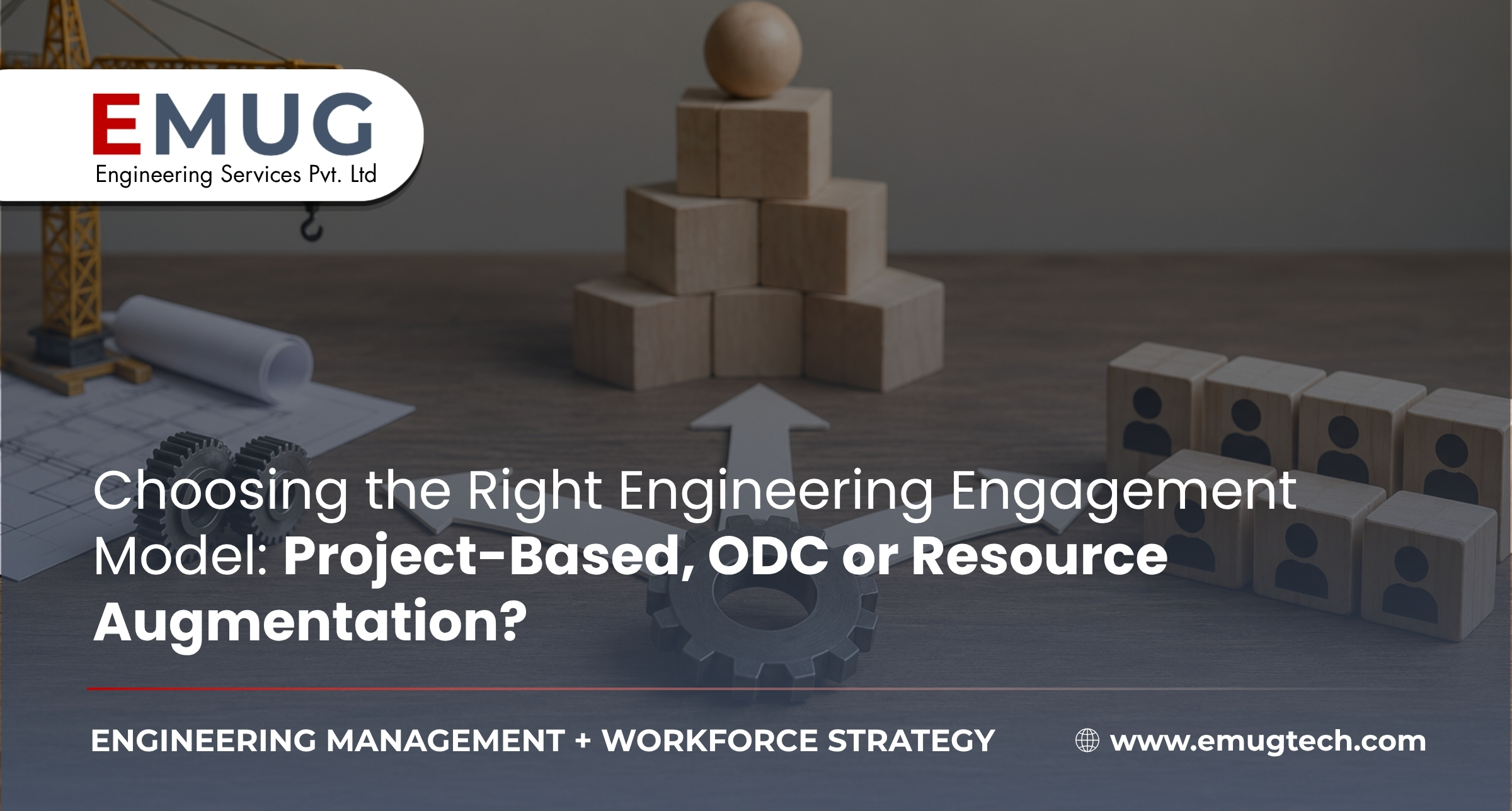
The three most widely adopted engineering engagement models are:
- Project-Based Delivery
- Offshore Development Centre (ODC)
- Resource Augmentation
Each serves a different business objective. Understanding when to use each model can significantly improve project outcomes.
Why Engagement Models Matter More Than Ever
Engineering complexity is increasing across industries.
According to Deloitte, over 70% of manufacturing and engineering organizations report talent shortages in critical technical roles. At the same time, product development cycles continue to shrink as companies race to deliver innovations faster.
Meanwhile, a McKinsey study found that organizations leveraging flexible external engineering ecosystems can reduce development timelines by up to 30%.
The question is no longer whether to engage external partners.
The real question is:
What is the most effective engagement structure for your business goals?
Model 1: Project-Based Engineering Services
Best For:
- Fixed-scope projects
- Product redesign initiatives
- Engineering automation implementations
- Simulation and validation projects
- CAD migration or PLM deployment programs
In a project-based model, the engineering partner owns delivery of a clearly defined scope, timeline, budget, and outcome.
The client focuses on business objectives while the service provider manages execution.
Advantages
✔ Predictable costs
✔ Defined deliverables
✔ Faster project startup
✔ Reduced management overhead
✔ Outcome-focused engagement
Potential Limitations
- Less flexibility when requirements change frequently
- Scope changes may require contract modifications
- Not ideal for long-term engineering capacity expansion
Example
An automotive OEM outsourcing a vehicle packaging study, BIW redesign, or CAE validation program typically benefits from a project-based engagement where outcomes are clearly measurable.
Model 2: Offshore Development Center (ODC)
Best For:
- Long-term product development
- Multi-year engineering programs
- Platform engineering
- Digital transformation initiatives
- Continuous product enhancement
An Offshore Development Center functions as an extension of your internal engineering team.
Instead of purchasing project outcomes, you build a dedicated engineering capability that works exclusively on your products, systems, and processes.
The ODC model has become increasingly popular among global OEMs seeking scalable engineering capacity without establishing new international facilities.
Advantages
✔ Dedicated engineering team
✔ Strong domain knowledge retention
✔ Higher scalability
✔ Better process alignment
✔ Long-term cost optimization
✔ Greater operational control
Potential Limitations
- Requires governance structure
- Longer onboarding period
- Best suited for sustained workloads
Example
A mobility company developing next-generation EV platforms, embedded systems, and digital engineering programs over several years often benefits from a dedicated ODC model.
Model 3: Resource Augmentation
Best For:
- Temporary skill gaps
- Program ramp-ups
- Specialized engineering expertise
- Peak workload management
- Urgent project requirements
Resource augmentation allows organizations to add engineers directly into existing teams while maintaining full management control.
The engineers work within the client’s processes, tools, and reporting structure.
Many organizations use resource augmentation to quickly access expertise in areas such as:
- CAD Engineering
- CAE Simulation
- Embedded Software
- PLM Administration
- Manufacturing Engineering
- SAP and Digital Transformation Programs
Engineering resource augmentation has become a preferred strategy for organizations that need flexibility without long-term hiring commitments.
Advantages
✔ Fast onboarding
✔ High flexibility
✔ Access to niche expertise
✔ Minimal hiring effort
✔ Easy scaling up or down
Potential Limitations
- Client retains management responsibility
- Knowledge continuity may vary
- Less suitable for outcome-based projects
Example
An aerospace supplier needing additional stress analysts for a certification program or an OEM requiring extra CAD engineers during a product launch would typically use resource augmentation.
How to Choose the Right Model
The best engagement model depends on four factors:
1. Scope Clarity
Clearly defined scope?
Choose: ➡ Project-Based Delivery
Evolving requirements?
Choose: ➡ ODC or Resource Augmentation
2. Duration
Less than 6 months?
Choose: ➡ Project-Based or Resource Augmentation
Multi-year roadmap?
Choose: ➡ ODC
3. Control Requirements
Want the partner to own outcomes?
Choose: ➡ Project-Based
Want direct management control?
Choose: ➡ Resource Augmentation
Want collaborative ownership?
Choose: ➡ ODC
4. Scalability Needs
Need 5 engineers today and 25 tomorrow?
Choose: ➡ ODC
Need 3 specialists for 4 months?
Choose: ➡ Resource Augmentation

The Emerging Trend: Hybrid Engagement Models
Increasingly, leading OEMs are not choosing one model.
They are combining multiple engagement structures.
For example:
- Resource augmentation during program launch
- Transition into an ODC for long-term execution
- Project-based delivery for specialized work packages
This hybrid approach provides both agility and scalability while reducing operational risk.
Organizations leveraging engineering ecosystems that combine mechanical, electrical, embedded, manufacturing, digital engineering, SAP, AI, and automation capabilities are often able to adapt faster to changing market conditions.
Final Thoughts
There is no universally “best” engineering engagement model.
The right choice depends on your business objectives, project maturity, internal capabilities, and growth plans.
The most successful organizations align engagement structures with strategic outcomes rather than procurement preferences.
When done correctly, the right model doesn’t simply fill capacity gaps.
It becomes a competitive advantage.
3 Actionable Takeaways
1. Evaluate Business Objectives Before Cost
The lowest-cost engagement model is not always the highest-value model. Align the structure with your long-term goals.
2. Match the Model to Project Maturity
Stable requirements Favor project-based delivery, while evolving roadmaps benefit from ODCs and augmentation.
3. Build Flexibility into Your Engineering Strategy
Consider hybrid engagement models that allow you to scale resources, expertise, and delivery ownership as programs evolve.
FAQs
1. What is the difference between Resource Augmentation and an ODC?
Resource augmentation provides individual engineers who work under your management. An ODC provides a dedicated team structure operating as an extension of your organization.
2. When should a company choose a Project-Based model?
When project scope, deliverables, timelines, and success criteria are clearly defined from the beginning.
3. Is an ODC suitable for startups?
Yes, especially for startups with long-term product roadmaps that require continuous engineering support without building large internal teams.
4. Which engagement model offers the fastest onboarding?
Resource augmentation typically enables the quickest deployment of engineering talent.
5. Can companies use multiple engagement models simultaneously?
Absolutely. Many OEMs combine project-based delivery, ODCs, and resource augmentation to optimize cost, flexibility, and delivery performance.
Discussion Question:
What engineering engagement model has delivered the best results for your organization Project-Based Delivery, ODC, Resource Augmentation, or a hybrid approach? What lessons have you learned along the way?